
Yoga Nidra: The Rest You Cannot Get Wrong
Guided deep rest, lying down, for people with no intention of becoming meditators.

Most people have never actually learned to rest
The working day ends and the body stops moving, but very little switches off. The evening fills with half-attention: a screen, a second screen, a mental rehearsal of tomorrow. Sleep is then asked to carry the entire weight of recovery, and when sleep is thin, nothing else picks up the slack.
Occupational psychology has a name for what tends to be missing here. It is called psychological detachment — the capacity to mentally step away from work once the work is over. A meta-analysis drawing on 316 independent samples and more than 99,000 participants found that relaxation experiences predicted positive affect, life satisfaction and wellbeing, while detachment specifically reduced exhaustion and negative affect.
The useful implication is not that everyone needs more downtime. It is that rest is a skill, and like most skills it goes better when something structures it.
What yoga nidra is
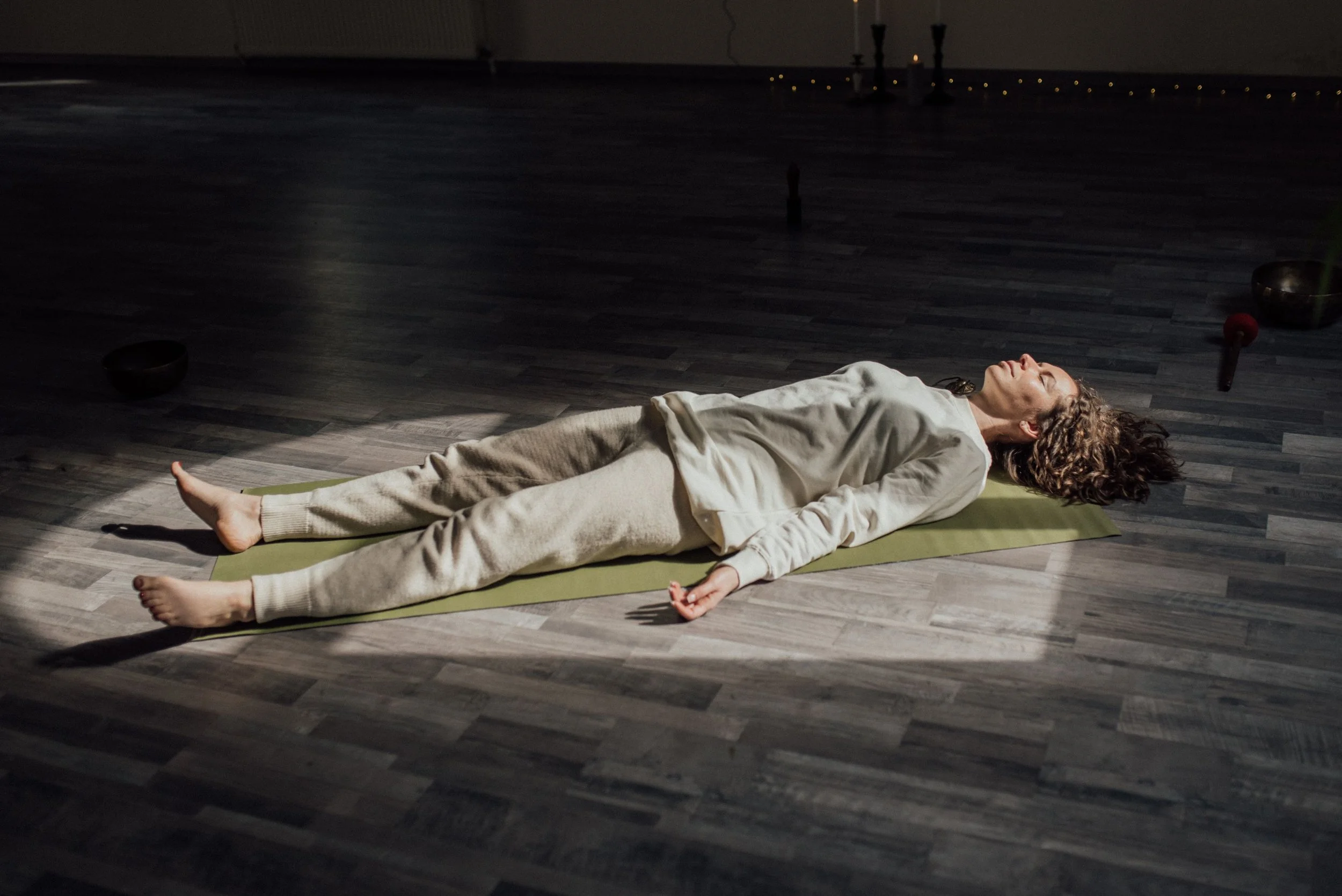
Yoga nidra is guided deep rest. You lie down, fully clothed, usually with a blanket and something under the knees, and a voice moves your attention slowly through the body, the breath, and a sequence of sensations and images. Nothing is required physically. Very little is required mentally, beyond letting the voice lead.
Calling it a relaxation technique undersells it. It is closer to a spoken descent into rest — a structured hour, or eleven minutes, in which the ordinary work of holding yourself together is temporarily handed over to someone else.
Why it is not meditation
This distinction matters more than it sounds, because the confusion is what stops most people trying.
Meditation trains attention.
You choose something to attend to, you hold it, the mind wanders, you bring it back. The returning is the training. Done consistently, it builds a capacity you carry into the rest of life. The effort is not an obstacle to meditation; the effort is the practice.
Yoga nidra withdraws attention.
It does not ask you to concentrate on anything. In the classical framework it sits under pratyahara, the deliberate turning of the senses away from the outside world — a stage that comes before concentration rather than a version of it.
The practical difference is straightforward. Meditation gives you a job to do. Yoga nidra takes the job away.
Meditation is usually done sitting upright, asks you to sustain and return your attention, and builds a capacity you carry into the rest of your life. Losing the thread without noticing is the thing to watch for. Yoga nidra is done lying down and fully supported, asks only that you follow a voice, and trains nothing at all — it simply produces a state of rest while it is happening. There is no equivalent way to get it wrong.
People who have concluded they are bad at meditation are rarely bad at yoga nidra. There is nothing in it to be bad at. And if you fall asleep, you were tired, which is information rather than failure.
Neither practice replaces the other. They are different tools for different jobs.
What the research actually shows
Yoga nidra has gone from folk practice to an active research literature in about a decade. Three findings are worth knowing.
The largest synthesis to date.
A 2026 systematic review and meta-analysis in the Annals of the New York Academy of Sciences pooled 73 studies covering 5,201 participants and found benefits for stress, anxiety and depression, with the effect on anxiety the most consistent across trials.
The most carefully controlled trial.
A 2025 randomised controlled trial in Stress and Health assigned 362 people to one of four groups: an eleven-minute recorded yoga nidra, a thirty-minute version, ten minutes of music, or a waiting list. Participants practised daily for two months. The eleven-minute group improved against the waiting list, regular practice was associated with lower total cortisol output and a steeper daily cortisol slope, and the short version outperformed the music control on low mood. Notably, eleven minutes did not underperform thirty.
The same finding, replicated at scale.
An earlier study in Current Psychology followed 771 people, half of whom practised an eleven-minute recording daily for a month. That group reported lower stress, better sleep quality and higher wellbeing than the control group.
For context on meditative practices generally, a review in JAMA Internal Medicine covering 47 trials and 3,515 participants found moderate evidence of improvement in anxiety, low mood and pain, with no evidence of harm.
The honest part
The researchers behind the 2026 review say plainly that the trials they pooled are of low methodological quality and that the large effect sizes are probably inflated. In the best-controlled trial, the effects were real but small.
So here is the fair summary. Yoga nidra is not a treatment and will not transform anyone’s life in a fortnight. It is a very much ‘inclusive and easy’ practice with no adverse events reported in the literature, which most people find calming, which measurably changed a daily stress hormone pattern in a controlled trial, and which works in eleven minutes.
For eleven minutes, that is an unusually good trade. Anyone promising more than that is ahead of the evidence.

What a session is actually like
You lie on your back on a mat or a bed, with as much support under you as you want.
A voice invites you to settle, then names parts of the body in sequence, one after another, fairly quickly.
Attention moves to the breath — counted, or simply noticed.
Images and sensations are offered, briefly, and then let go.
There are silences. They are deliberate, and they are where most of the rest happens.
At the end you are brought back gradually, not startled awake.
There is no chanting requirement, no flexibility requirement, and nothing to memorise. Most people are surprised by how much longer the session felt than it was, or how much shorter.

How to begin
Start with eleven minutes, not thirty. Pick the same slot each day — after work, or early afternoon when energy dips. Give it two weeks before deciding whether it suits you, which is roughly the point at which the studies started measuring change.
Lie down somewhere you can be uninterrupted, put the phone face down, and let someone else do the thinking for a few minutes.
Evening Rest · 30-Minute Yoga Nidra
A guided deep rest every Tuesday at 7pm, live online. No experience needed, just somewhere comfortable to lie (or sit) down.
References
Ghai S, Odyniec P, Ghai I. Effects of Yoga Nidra on stress, anxiety, and depression: a systematic review and meta-analysis. Annals of the New York Academy of Sciences. 2026. pubmed.ncbi.nlm.nih.gov/41327816/
Moszeik EN, Rohleder N, Renner KH. The effects of an online yoga nidra meditation on subjective well-being and diurnal salivary cortisol: a randomised controlled trial. Stress and Health. 2025;41(3):e70049. pubmed.ncbi.nlm.nih.gov/40373021/
Moszeik EN, von Oertzen T, Renner KH. Effectiveness of a short Yoga Nidra meditation on stress, sleep, and well-being in a large and diverse sample. Current Psychology. 2022;41(8):5272–5286.
Goyal M, Singh S, Sibinga EMS, et al. Meditation programs for psychological stress and well-being: a systematic review and meta-analysis. JAMA Internal Medicine. 2014;174(3):357–368.
Steed LB, Swider BW, Keem S, Liu JT. Leaving work at work: a meta-analysis on employee recovery from work. Journal of Management. 2021. See also Sonnentag S, Fritz C. Journal of Occupational Health Psychology. 2007;12:204–221.